
How to make soy candles: temperatures, fragrance load and fixes for common soy problems
October 11, 2026 · 3 min read
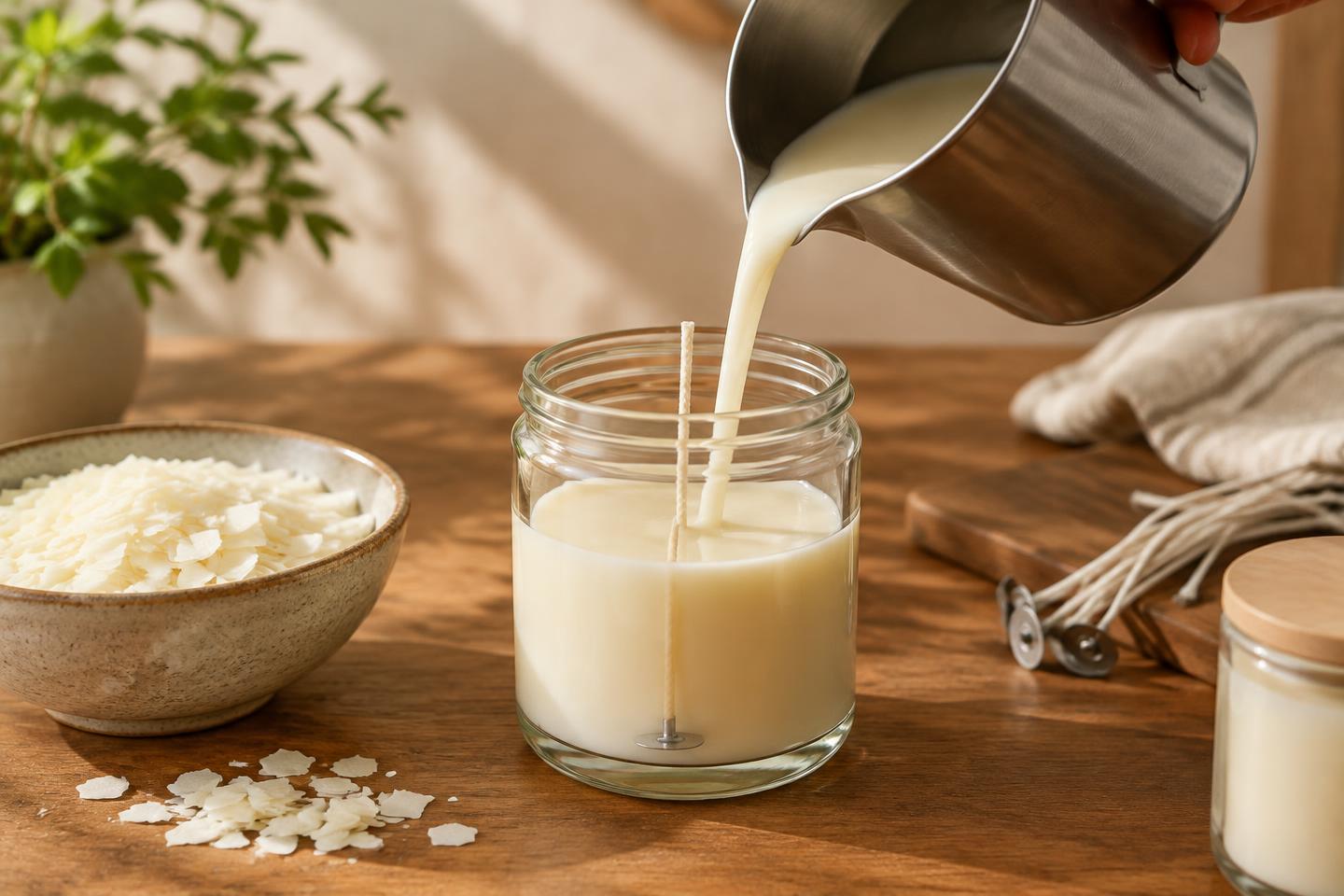
The short answer: soy candles are made like any container candle, but soy wax is more sensitive to temperature and cure time. Heat it to the temperature on your wax's data sheet, add fragrance oil hot, stir well, pour at the recommended pour temperature into a warm jar, cool slowly, and cure for about one to two weeks before judging scent. Most soy problems — frosting, wet spots, rough tops, weak throw — trace back to temperature and cure.
Why soy behaves differently
Soy is a natural wax that can crystallize as it cools, which is why it is prone to frosting (white crystal bloom) and to pulling away from glass. These are mostly cosmetic, but they matter to customers. Our soy frosting and wet spots guide goes deep on each defect.
Soy candle process at a glance
| Step | What to do | Why it matters |
|---|---|---|
| Melt | Heat to the temperature on your wax's data sheet | Fully melts all crystals for a smooth finish |
| Add fragrance | Add oil at the supplier's recommended temperature | Helps oil bind for better throw |
| Stir | Gently, about two minutes, then again before pouring | Even distribution without air bubbles |
| Pour | Cool to pour temperature; warm jars help adhesion | Reduces wet spots and rough tops |
| Cool | Room-temperature, draft-free spot | Fast cooling encourages sinkholes and frosting |
| Cure | Often 1–2 weeks for soy | Hot throw improves as the wax cures |
CandleScience's soy candle tutorial shows example temperatures for its soy waxes. Different soy waxes have different numbers — use the ones for your wax.
How much fragrance oil in soy wax?
Many container soy waxes list a maximum fragrance load around 10–12%, but the right number for your candle is often a little below the maximum. Start one or two points under the max, test, and adjust. Always stay within the fragrance's IFRA limit for candles too — see IFRA vs wax limits.
Calculated as wax weight × load. 16 oz of wax at each percentage. Not a recommendation for any specific wax.
Chart data
| Item | Value ( oz) |
|---|---|
| 6% | 0.96 oz |
| 8% | 1.28 oz |
| 10% | 1.6 oz |
| 12% | 1.92 oz |
Wicking soy candles
Soy has a relatively high viscosity when melted, so it often needs a different wick than paraffin in the same jar. Test at least two wick sizes with your exact fragrance and load; dark or dense fragrances can change the result. Our tunneling and melt pool guide shows how to judge a wick over the whole candle, not just the first burn.
Quick fixes for common soy problems
- Frosting: pour a bit cooler, cool slowly, and accept some bloom as a natural soy trait.
- Wet spots: warm jars before pouring, clean glass thoroughly, avoid cold drafts.
- Rough or cracked tops: use a heat gun lightly on the surface or do a small second pour.
- Sinkholes near the wick: pour slower and cool at room temperature.
- Weak hot throw: cure longer, check wick size, then reconsider fragrance load.
WaxLogic records each batch's recipe so you can compare results; the free candle calculator gives you exact soy and oil weights for any jar. Choosing between waxes? Read soy vs paraffin vs coconut and candle cure time explained.
Run your candle business in one place
Inventory, recipes, production, wholesale and invoicing — 7 days free, no card needed.
Start free trial