
Soy candle frosting and wet spots: a troubleshooting guide that separates appearance from safety
October 7, 2026 · 5 min read
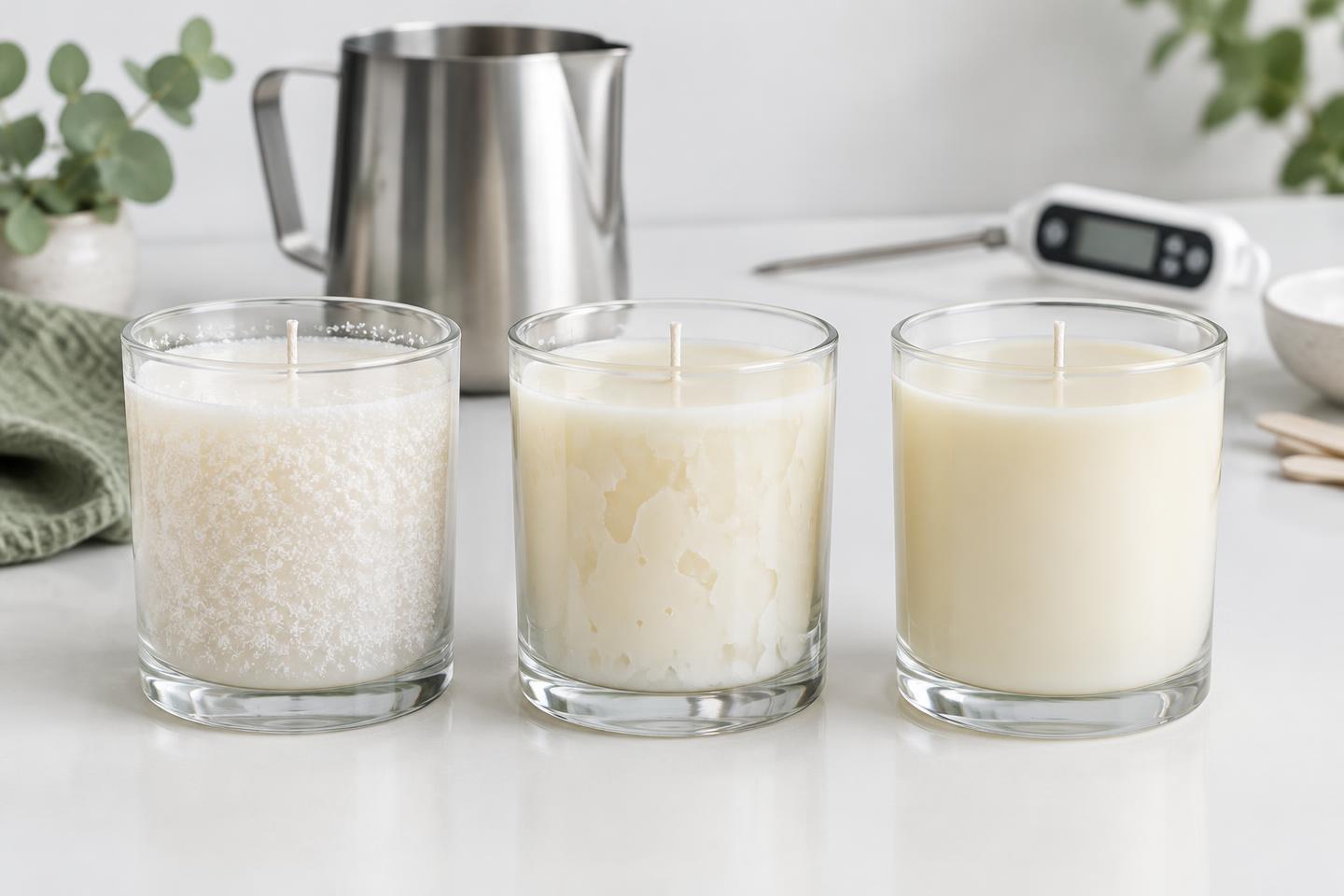
The short answer: soy candle frosting is a whitish crystalline appearance on the wax. Wet spots are patches where cooled wax has pulled away from the glass, not necessarily liquid. Both are commonly cosmetic. Oil on the surface, a displaced wick, cracked glass or unstable burning are different problems and should not be dismissed as normal soy character.
A candle that looks imperfect is not automatically unsafe, and a candle with a perfect top is not automatically ready to sell. The useful skill is learning which observation belongs in an appearance check, which requires a process adjustment and which means holding a batch for investigation. This guide is for container soy candles; follow the instructions for your exact wax and vessel rather than borrowing settings from a different blend.
First identify what you are actually seeing
| Observation | Possible explanation | First action |
|---|---|---|
| White, chalky crystals | Frosting from wax crystallization | Photograph and compare cooling conditions |
| Clear-looking patches against glass | Wax shrinkage or uneven glass adhesion | Check clean, dry jars and cooling consistency |
| Rough or pitted top | Crystal formation or trapped air | Check mixing and supplier pour guidance |
| Liquid oil or oily beads | Too much fragrance or poor incorporation | Hold the batch; review load and mixing |
| Hole near wick or sunken area | Possible shrinkage void or trapped air | Investigate before treating only the surface |
| Off-center wick or cracked jar | Assembly or vessel problem | Do not release for sale |
Use this table as a starting point, not a diagnosis from a photograph. CandleScience's soy wax troubleshooting guide distinguishes frosting and glass pull-away from fragrance leaching. It also explains that ordinary frosting does not itself change how the candle burns or smells. That does not clear a separate wick, fragrance or vessel issue.
Why frosting happens, and what is worth changing
Soy wax forms crystals as it cools and ages. Visible frosting can appear on the sides or top, and color can make it easier to notice. Your goal is a repeatable finish appropriate to your product, not a promise that natural wax will never change appearance. An attractive sample photographed the day after pouring may look different after storage or transport.
- Start with the wax supplier's recommended processing conditions and record actual temperatures, not just what you intended to do.
- Keep mixing controlled. Aggressive agitation can introduce air and may aggravate appearance problems.
- Keep jars clean and completely dry. If the supplier recommends pre-warming, follow its temperature and handling guidance rather than improvising.
- Avoid drafts and uneven cooling. Compare where jars sit on the workbench and how tightly they are grouped.
- Test a small pour-temperature change within supplier guidance. Keep all other settings unchanged so the result means something.
There is no universal pour temperature that fixes every soy wax. A setting that works for one blend, fragrance and room may disappoint with another. CandleScience suggests testing temperature adjustments in small increments; use that as a controlled experiment, not a reason to overwrite every recipe with someone else's favorite number.
Wet spots are not the same as leaking fragrance
Wax can cool faster in one part of a jar than another. Some areas remain attached to the glass while others pull away, creating an optical patch. This is the common adhesion issue called a wet spot. Actual oily droplets or a wet surface are a separate observation. If you cannot distinguish them, hold the candle and ask the supplier rather than explaining it away to a customer.
For ordinary pull-away, compare jar preparation, pour speed, room conditions and spacing. A cold counter or jars crowded together may create uneven cooling. Moving to opaque vessels can hide an appearance issue, but changing the vessel is a product change: the new combination needs its own burn testing. It is not a shortcut around quality assurance.
Run a one-variable test, not a full recipe reset
| Trial | Change | Keep constant | Compare |
|---|---|---|---|
| A: baseline | None | Wax, fragrance, wick and jar | Finish at 24 hours and after storage |
| B: temperature | One small supplier-approved pour adjustment | Everything except pour temperature | Frosting, adhesion and top texture |
| C: cooling | More consistent spacing and no draft | Baseline recipe and pour temperature | Uneven pull-away and appearance |
Make more than one candle per condition when practical. A single beautiful jar may be luck. Photograph under the same lighting, note room conditions and wait the same interval before comparing. Choose a setting that repeats across several pours, then check performance using your established cure and burn-test protocol. An appearance improvement is not proof of better combustion.
Avoid spending more on rework than the defect costs
A heat gun may smooth a superficial top, but it does not validate an oil-loading problem or eliminate a deeper void. Repeatedly reheating every candle also adds labor. For an illustrative batch of 24, three minutes of rework per unit is 72 minutes. At an internal labor allowance of $20 per hour, that adds $24 to the batch, or $1 per candle. Record that time in your cost-per-candle calculation before deciding the finish is profitable.
Questions candle makers ask
- Can I sell a frosted soy candle? Ordinary frosting alone is generally cosmetic, but release should still depend on your full safety, performance and appearance checks. Describe natural variation honestly.
- Will more fragrance hide the problem? It is not a frosting fix. Stay within your wax guidance and the fragrance documentation, and test performance.
- Should I wick up to improve the top? Do not change a wick to solve a cosmetic problem. Wick selection is a burn-performance decision.
Keep appearance notes alongside the recipe and pour date so the next batch teaches you something. WaxLogic's product recipes, batches and burn-test logs can support that recordkeeping. Start with the wick-testing guide, calculate consistent weights with the free candle calculator, and use the National Candle Association's fire-safety guidance as consumer-safety context—not a substitute for product testing.
Run your candle business in one place
Inventory, recipes, production, wholesale and invoicing — 7 days free, no card needed.
Start free trial