
Why is my candle sweating? The logic of fragrance oil on top and how to troubleshoot it
October 18, 2026 · 8 min read
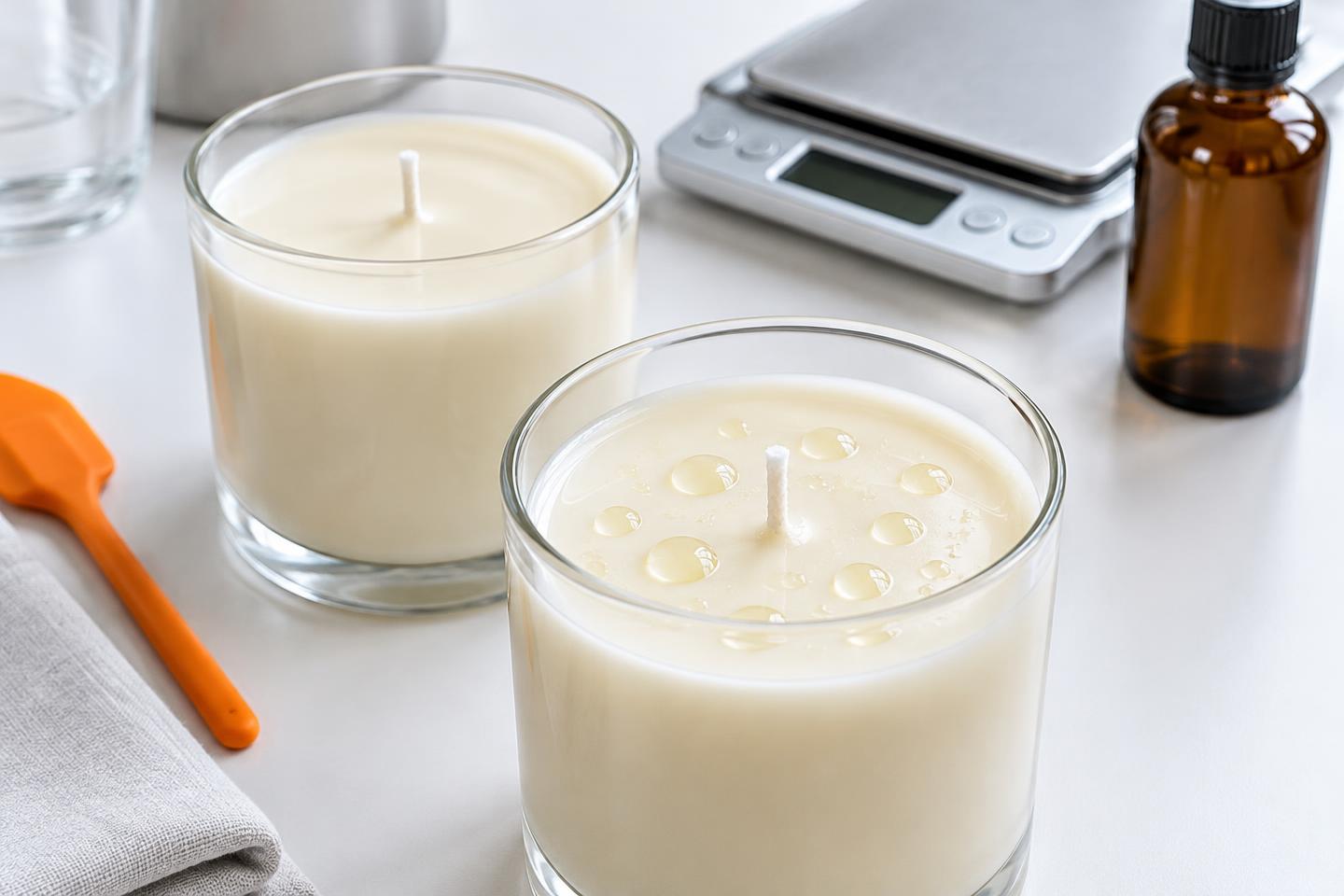
The short answer: candle sweating usually describes liquid droplets or an oily film appearing on solid wax. Possible contributors include more fragrance than the wax can retain, inadequate incorporation, and storage-temperature changes. But a shiny patch against the glass is often a wet spot caused by wax pulling away, not leaking oil. Identify what is actually wet before changing your recipe. Hold candles with unexplained surface liquid out of saleable stock; wiping them dry does not establish that the formula is suitable to burn.
Candle sweating, wet spots, frosting or condensation?
These problems can look similar in a photo but need different responses. A wet spot is a change in the contact between wax and glass. Frosting is visible crystal growth. Sweating describes actual liquid at the surface. Moisture on the outside of a cold jar may be condensation, but its location alone cannot prove what a liquid is. Do not diagnose oil by touching or smelling an unknown substance.
| Observation | What it may indicate | Next step |
|---|---|---|
| Shiny patch between solid wax and glass; dry top | Glass adhesion / wet spot | Compare with the wet-spot guide; inspect for other defects |
| White, dry crystalline pattern | Frosting, especially in soy wax | Record appearance separately from burn performance |
| Droplets or greasy-looking film on wax | Possible fragrance separation / sweating | Hold the batch; check formula, mixing and storage records |
| Moisture outside a jar moved from cold to warm air | Possible condensation | Let it equilibrate unopened; investigate any liquid inside |
| Softened, slumped wax after a hot delivery | Heat exposure; possibly accompanied by separation | Quarantine affected units and consult the supplier |
Our soy frosting and wet spots guide covers dry appearance defects in more detail. The important distinction here is that an oily top is not automatically the same harmless cosmetic issue.
Why fragrance oil can appear on top of a candle
- Fragrance load: a supplier's maximum is a ceiling for that wax, not a guarantee that every fragrance will work well at that amount. A lower tested load may be appropriate.
- Incorporation: adding fragrance outside the supplier's recommended conditions or mixing inconsistently can make the process less repeatable. Review the exact wax and fragrance instructions rather than copying another maker's temperature.
- Temperature history: compare candles stored in your studio with those exposed to warm windows, cold rooms or delivery conditions. A defect that appears after shipping deserves its own investigation.
- Material or formula changes: a new fragrance, wax blend, additive or supplier lot can change performance even if the scent name and percentage are unchanged.
These are investigation paths, not proof of a single cause. A perfectly recorded percentage cannot rule out incompatibility, and an oily-looking top does not establish that the maker definitely used too much fragrance.
Candle Shack's sweating troubleshooting guidance discusses fragrance incorporation, loading and temperature-related issues. CandleScience's soy wax troubleshooting guide distinguishes fragrance leaching from frosting and glass adhesion. Use these as a diagnostic framework, then follow the technical guidance for your exact materials—not a universal temperature or mixing time.
Check fragrance-load math before changing temperatures
Most candle recipes express fragrance load relative to wax mass: fragrance oil weight ÷ wax weight × 100. Use weight ounces, not fluid ounces. If your supplier defines the percentage differently, use that definition and label your records clearly. Confusing a wax-based ratio with a percentage of the total mixture changes how much oil you add.
| Starting information | Calculation | Result |
|---|---|---|
| 20.00 oz of wax, 8% wax-based load | 20.00 × 0.08 | 1.60 oz fragrance; 21.60 oz total mixture |
| 20.00 oz total mixture, 8% wax-based load | Wax = 20.00 ÷ 1.08; oil = 20.00 − wax | 18.52 oz wax; 1.48 oz fragrance (rounded) |
| 20.00 oz total mixture, oil is 8% of total | Oil = 20.00 × 0.08; wax = 20.00 − oil | 1.60 oz fragrance; 18.40 oz wax—8.70% relative to wax |
The third line is not the same recipe as an 8% wax-based load. On small test pours, scale resolution and rounding matter too: weigh carefully rather than measuring fragrance in a spoon or assuming its volume equals its mass. The fragrance-load explainer and free candle calculator help separate those quantities.
Calculated examples only, not recommended loads or experimental results. Use only a percentage allowed by your exact wax and fragrance documentation, then validate the complete candle.
Chart data
| Item | Value ( oz) |
|---|---|
| 6% of wax weight | 1.2 oz |
| 8% of wax weight | 1.6 oz |
| 10% of wax weight | 2 oz |
A practical troubleshooting sequence
- Hold the affected batch. Label it clearly and separate it from orders waiting to ship. Record the batch number and which units show liquid.
- Photograph the surface and glass in consistent light. Record when the liquid first appeared: after setting, during cure, in storage or after delivery.
- Recalculate the actual wax-based load from weighed amounts. Include every fragrance in a blend; adding two oils does not create two separate loading allowances.
- Compare the recipe with the exact wax technical sheet and current fragrance-use documentation. Check that the wax is intended for your product format.
- Review addition temperature, mixing method, pour temperature and storage history. Note missing measurements rather than filling them in from memory.
- Send the supplier your formula, material lots, photos and process notes. Ask for product-specific guidance before reworking or releasing affected stock.
- Make small controlled samples with a suitable formulation. Cure and evaluate them under the supplier's guidance, then perform full-life burn testing before selling a changed candle.
Build a small test that can actually explain something
Start with the variable your records make most plausible. If fragrance load is the question, compare two supplier-permitted loads while keeping wax, fragrance lot, jar, wick, mixing method, cure conditions and storage conditions the same. Make replicate samples so one unusually good jar does not decide the outcome. Do not simultaneously lower fragrance, change wick and pour colder—you will not know which change mattered.
| Record | Sample A | Sample B |
|---|---|---|
| Wax-based load | Lower supplier-permitted test load | Current load, only if supplier-permitted |
| Materials and process | Same wax/oil lots, vessel, wick and process | Same as A |
| Surface observations | Photos after set, after cure and during storage | Use the same observation schedule |
| Burn evaluation | Complete-candle testing after appropriate cure | Same protocol and environment |
| Decision | Review appearance and burn behavior together | Do not choose on scent strength alone |
A dry top is one observation, not a safety certification. Changes in fragrance load can affect the whole candle, so evaluate flame behavior, soot, wick performance and vessel condition as well. Use the wick testing guide for a structured record and the hot and cold throw guide for controlled scent comparisons.
Does curing fix candle sweating?
Curing gives a candle time before performance testing; it is not permission to ignore separated liquid. A surface that looks better later does not establish that the underlying formula is sound. Follow your wax supplier's cure guidance, document any change in appearance, and investigate recurring oil instead of extending the cure period indefinitely. See candle cure time explained for the difference between setting and readiness for testing.
What if candles sweat only after shipping?
Compare retained studio samples with the reported delivery conditions. Ask for photos, when the parcel arrived, whether it sat in sun or a hot vehicle, and whether the wax is distorted. Packaging can reduce exposure, but insulation is not temperature control and cannot rescue an unsuitable recipe. Review dispatch timing, wax choice and seasonal handling with your supplier; our candle shipping guide covers breakage and heat exposure together.
Fragrance limits and the records worth keeping
The wax's loading guidance and a fragrance's IFRA use limit answer different questions. An IFRA certificate does not establish that oil will stay incorporated in your wax, nor does it replace burn testing. Check the appropriate application and percentage basis for the exact fragrance; the IFRA versus wax-limits guide explains why the larger number is not automatically a usable recipe.
- Exact wax name and lot; fragrance name, supplier and lot; any dye or additive.
- Actual weighed wax and oil, the ratio definition and scale used.
- Measured addition and pour temperatures, mixing method, pour date and cure conditions.
- First observed liquid, photos, storage or shipping history and affected unit count.
- Supplier advice, test-sample identities, findings and the final hold/rework/release decision.
WaxLogic product recipes and batch notes can keep the approved formula and investigation together. Use the batch QC checklist to make an unexplained oily top a documented hold decision—not something that quietly disappears when someone wipes the jar. The logic is simple: identify the liquid, verify the math, test one change, and release only a product you have actually evaluated.
Run your candle business in one place
Inventory, recipes, production, wholesale and invoicing — 7 days free, no card needed.
Start free trial