
Fragrance load, explained: the math behind a candle that actually throws
October 5, 2026 · 4 min read
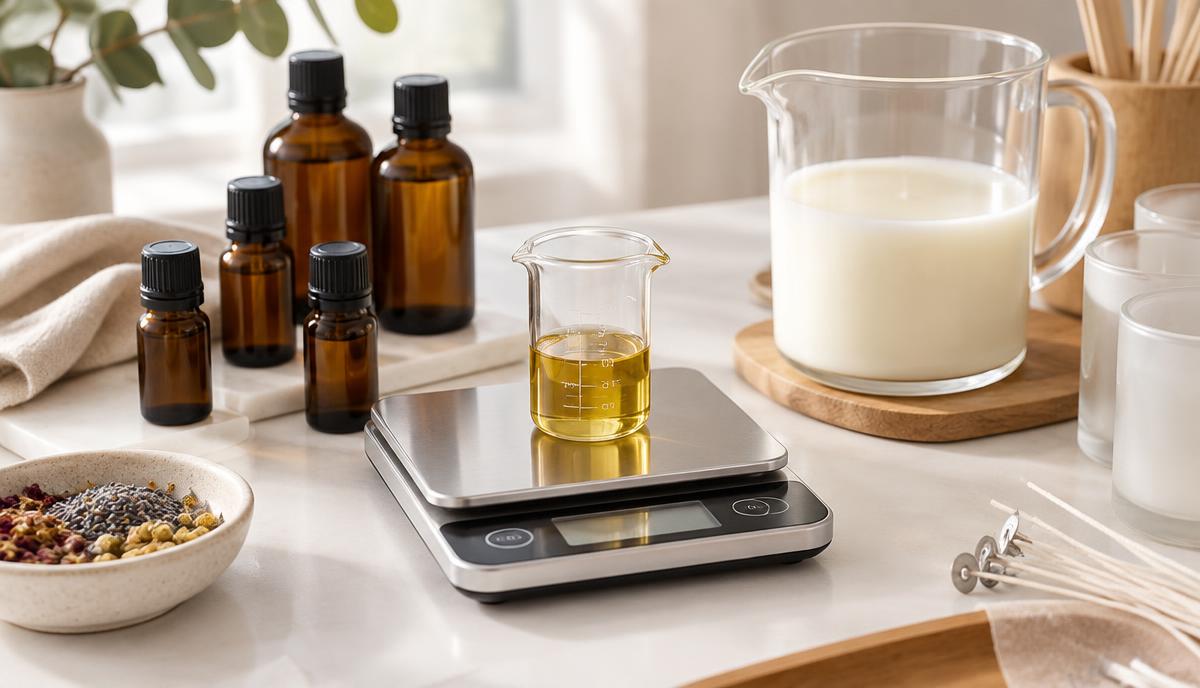
Ask ten candle makers what fragrance load they use and you'll get ten answers, usually delivered with total confidence. Six percent. Ten percent. "A splash more than the jar says." The problem is that fragrance load is one of the few numbers in your business that directly controls both how your candle performs and what it costs you — and it's the one most people eyeball.
Fragrance load is simply the weight of fragrance oil as a percentage of the weight of wax. If your batch has 1,000 grams of wax and you want a 9% load, you need 90 grams of fragrance oil. That's it. The confusion creeps in because some suppliers quote load as a percentage of the total batch (wax + oil) instead of the wax alone — at higher loads the two methods drift apart, and your costs drift with them.
Here's a worked example. You're pouring 24 candles in vessels that each hold 8 fluid ounces of water. Water weighs roughly 29.6 grams per fluid ounce, so your vessels hold about 5,684 grams of water total. Soy wax is less dense than water — around 0.86 — so you need about 4,888 grams of wax to fill them. At a 9% fragrance load, that's 440 grams of oil. At fragrance prices anywhere from $20 to $40 a pound, the difference between an 8% and a 10% load on that single batch is real money, multiplied by every pour day of the year.
If you'd rather not do that math on scratch paper, our free candle calculator works out exact wax and fragrance weights for any vessel count, wax type, and load percentage — including a custom density for blended waxes.
There's also a ceiling to respect. Every wax has a maximum fragrance load it can hold before the oil starts to seep out or the burn turns unsafe — most container soy waxes top out around 10–12%. Pushing past it doesn't make a stronger candle; it makes a sweaty, sooty one. The National Candle Association's safety guidance is worth a read if you're ever tempted to treat "more" as "better."
The makers who get this right treat fragrance load as a recipe decision, not a pour-day guess. The percentage lives in the recipe, the batch math comes from the recipe, and the cost per candle updates automatically when oil prices change. That's the approach we built into WaxLogic — your recipes drive your production batches and your costing, so the number you decided on is the number that actually goes in the pot.
Run your candle business in one place
Inventory, recipes, production, wholesale and invoicing — 7 days free, no card needed.
Start free trial