
How to make beeswax candles: jars, pillars and how to wick 100% beeswax
October 13, 2026 · 3 min read
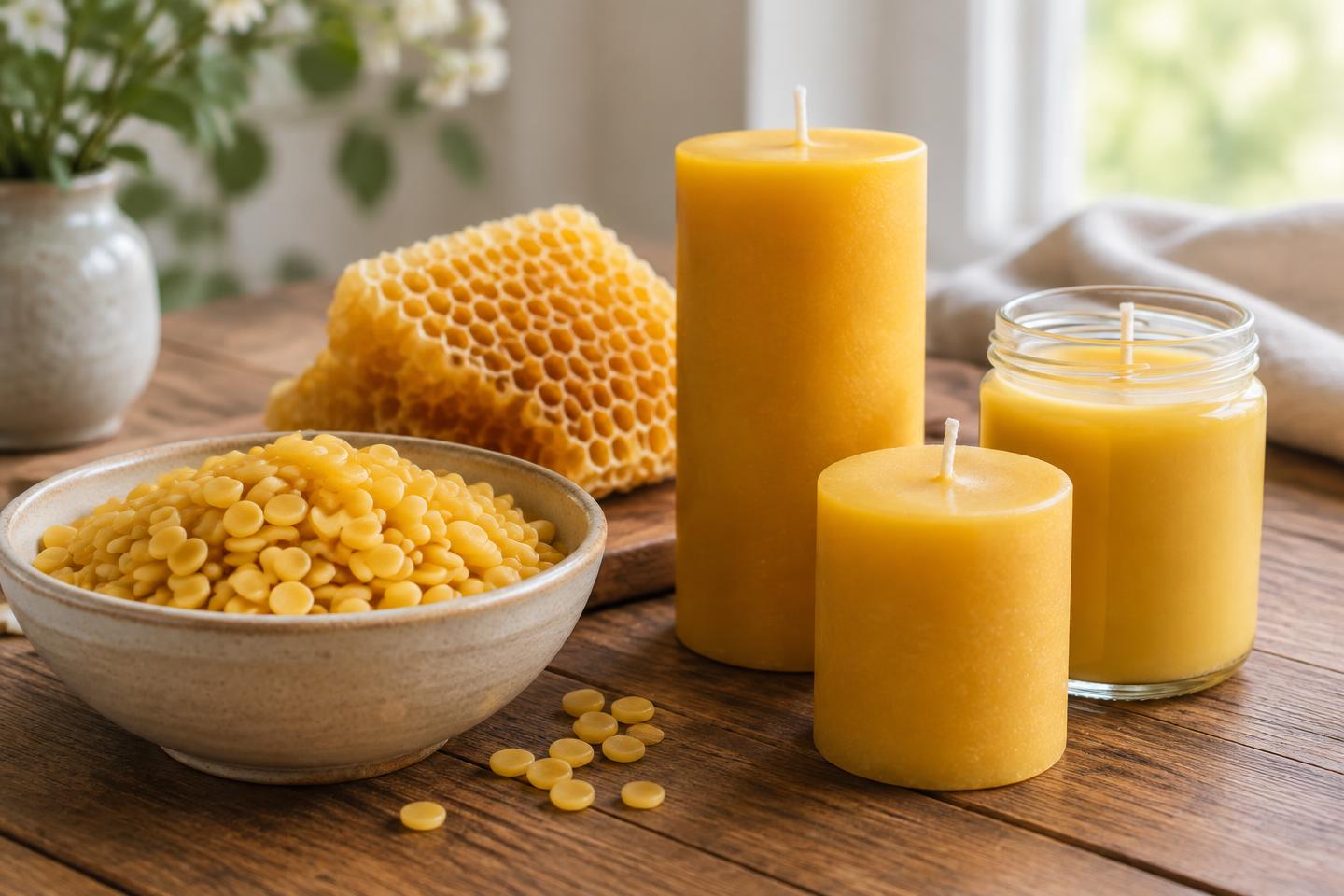
The short answer: to make beeswax candles, melt filtered beeswax gently in a double boiler, pour it into a warmed jar or pillar mold with a wick sized for beeswax, cool slowly to avoid cracks, and burn-test. Beeswax is harder, denser and has a higher melting point than soy, so it usually needs a larger wick than soy in the same diameter. Many makers leave beeswax unscented for its natural honey aroma.
Beeswax compared with soy and paraffin
| Property | Beeswax | What it means for you |
|---|---|---|
| Hardness | Hard, dense | Great for pillars, tapers and molds |
| Melting point | Higher than most soy | Needs a hotter, larger wick |
| Natural scent | Light honey aroma | Often sold unscented |
| Color | Yellow to white (filtered/bleached) | Natural color varies by batch |
| Cost | Usually higher per pound | Price beeswax lines higher |
CandleScience's wax guide explains how candle type, natural preference, color and throw decide which wax to use. Beeswax shines in pillars and molded shapes where its hardness is an advantage.
How to make a beeswax jar candle
- Use cosmetic-grade or candle-grade filtered beeswax pellets.
- Melt in a double boiler — never over direct heat — and monitor the temperature.
- Warm the jar slightly to reduce cracking and pull-away.
- Secure a wick sized for beeswax at the center; it is often one or more sizes larger than for soy.
- Pour slowly and let cool at room temperature, away from drafts.
- If the surface cracks or sinks, top off with a small second pour.
- Let the candle set fully, then burn-test top to bottom.
Beeswax pillars and molded candles
Beeswax releases well from silicone and metal molds and holds sharp detail. Use a wick designed for pillars, and because pillars burn without a container, test for dripping and guttering. A freestanding candle should always burn on a heat-resistant holder.
Fictional teaching data showing why beeswax often needs a larger wick than soy. Test your own materials.
Chart data
| Item | Value ( in) |
|---|---|
| 1 hr | 1.6 in |
| 2 hr | 2.1 in |
| 3 hr | 2.4 in |
| 4 hr | 2.6 in |
In the example, a wick that would fully melt a soy candle leaves a beeswax candle short of the edge after four hours — a sign to test the next wick size up.
Can you add fragrance to beeswax?
You can, but beeswax's natural aroma and dense structure mean scent throw is often lighter than in soy or paraffin blends. Test lower loads first and check the fragrance's limits for candles. Many beeswax sellers market the natural honey scent instead. See fragrance load, explained.
Fixing common beeswax problems
- Cracks: warm the jar and cool slowly; a heat gun can smooth the surface.
- Tunneling: size the wick up for beeswax's higher melt point.
- White bloom on surface: a natural trait of beeswax; it can be buffed off.
- Pulling away from glass: warm jars and slow cooling help.
Use the free candle calculator for fill weights, and compare waxes in soy vs paraffin vs coconut. Keep beeswax batches in WaxLogic so each lot and wick result stays on record.
Run your candle business in one place
Inventory, recipes, production, wholesale and invoicing — 7 days free, no card needed.
Start free trial