
How to calculate your true cost per candle (including the costs most makers miss)
October 8, 2026 · 5 min read
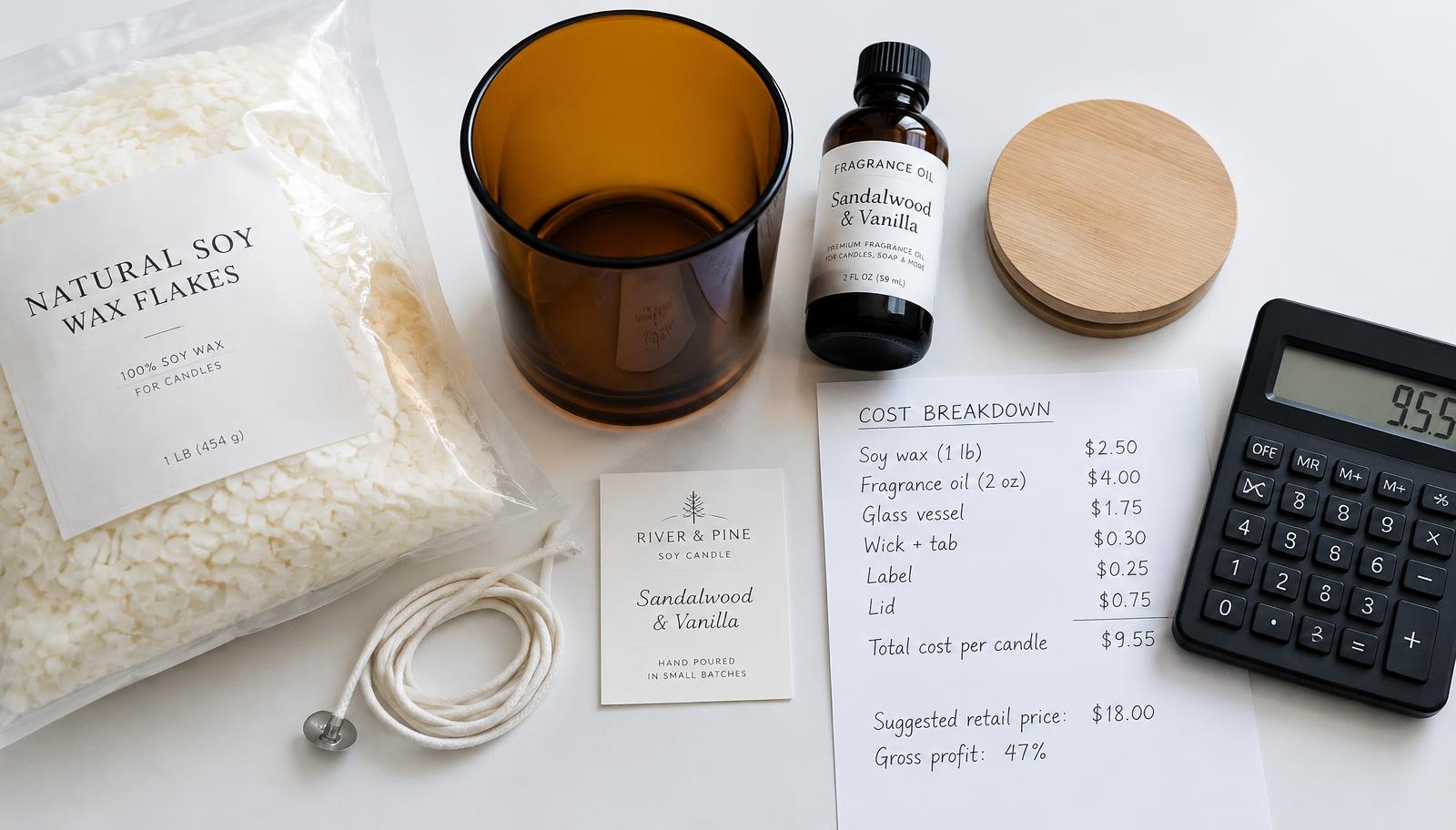
The short answer: your true cost per candle = (wax + fragrance + wick + vessel + lid + label + packaging) + labor per candle + overhead per candle. Most makers only count the first two, which is why so many candles are priced at a loss without anyone noticing.
We call this the WaxLogic Full-Cost Method: every candle carries three layers of cost — materials, labor, and overhead — and a price is only safe once all three are covered. Here's how to work out each layer.
Layer 1 — Materials. Divide what you paid for each material by how much you got, then multiply by how much one candle uses. Wax and fragrance are measured by weight: if a 10 lb bag of soy wax cost $25, that's $2.50 per pound, or about $0.0055 per gram. Fixed parts — the wick, vessel, lid, warning label, brand label, and box — are just their unit cost. Include the shipping you paid on supplies too; freight is part of what a material really costs you.
Layer 2 — Labor. Time a full pour day from setup to cleanup, multiply by the hourly wage you'd pay someone (even if that someone is you), and divide by the number of candles poured. Leaving your own time out doesn't make candles cheaper — it just hides the cost until you try to hire help.
Layer 3 — Overhead. Add up monthly costs that aren't tied to a single candle — studio rent, utilities, software, insurance, market fees — and divide by the candles you make in a typical month.
A worked example for an 8 oz soy candle (illustrative prices — use your own): wax $0.95, fragrance oil at a 9% load $0.80, wick $0.10, vessel $1.60, lid $0.40, labels $0.25, box $0.50. Materials total $4.60. Labor: a 4-hour pour day at $20/hour making 48 candles adds $1.67. Overhead: $300 a month across 300 candles adds $1.00. True cost: $7.27 per candle — about 58% more than the $4.60 most people would have written down.
Why it matters for wholesale: retail partners typically buy at around half of retail price. If you priced that candle at $14 based on materials alone, your wholesale price of $7 sits below your real cost of $7.27 — every case you ship to a store loses money. A common rule of thumb is to set retail at least 2x to 2.5x your true cost so wholesale still leaves a margin.
To get your wax and fragrance weights right before you price anything, our free candle calculator works them out for any vessel size, wax type, and fragrance load. For a deeper dive on that number, read fragrance load, explained. The U.S. Small Business Administration's guide on calculating startup and operating costs is also a solid reference for estimating overhead.
The catch with any cost sheet is that it goes stale the moment a supplier raises prices. In WaxLogic, cost per candle is calculated straight from your recipes and your latest material costs — including freight on purchase orders — so when fragrance goes up, every product's cost updates on its own. You can try it free for 7 days.
Run your candle business in one place
Inventory, recipes, production, wholesale and invoicing — 7 days free, no card needed.
Start free trial