
Margin Logic: how many candles must you sell to break even at a craft fair?
October 7, 2026 · 6 min read
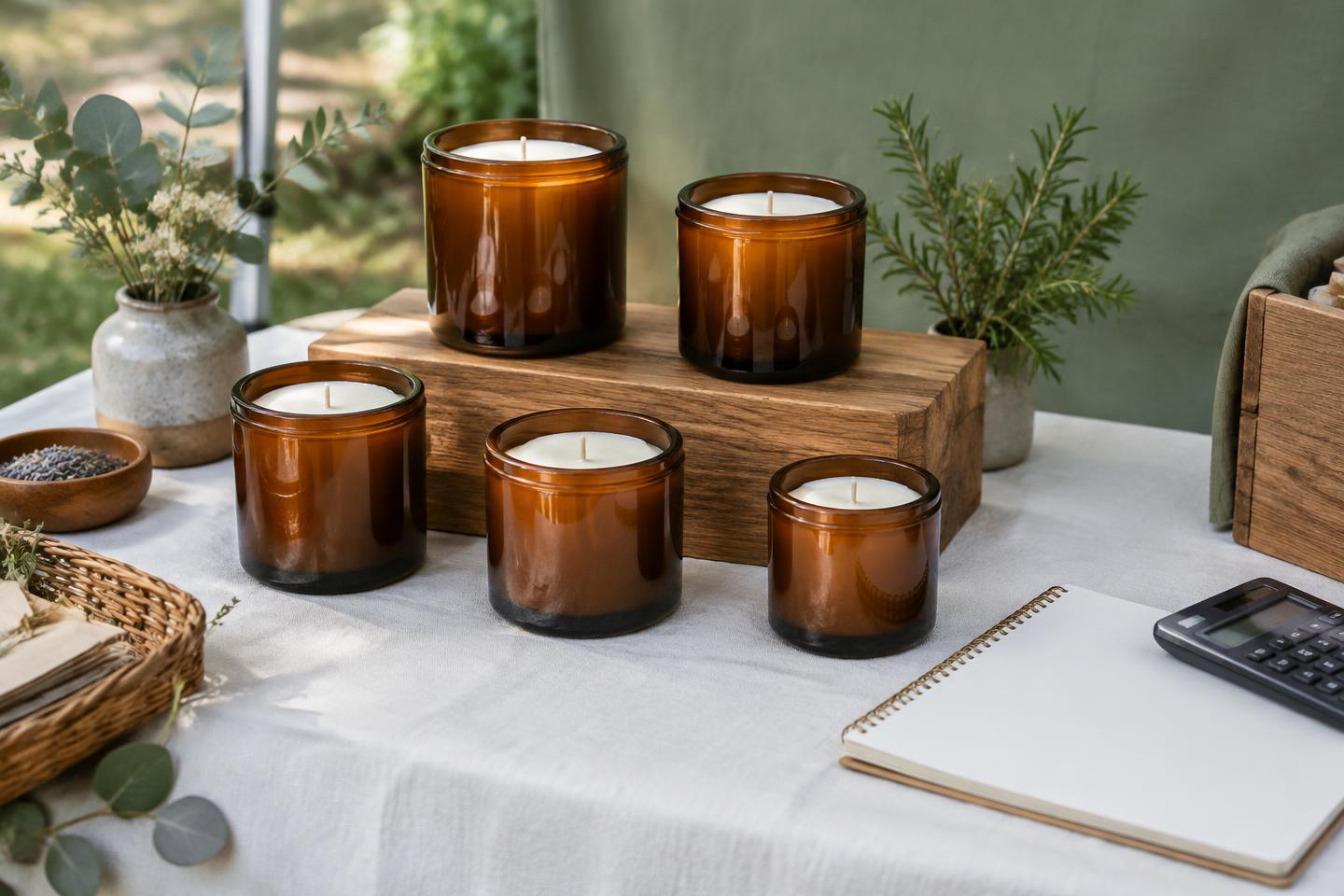
The short answer: divide your event's fixed costs by the contribution you keep from each candle sold, then round up. Contribution per candle is selling price minus per-unit costs that increase with a sale. If fixed costs are $240 and each candle contributes $14, you need to sell 18 candles to cover that event. Revenue alone cannot tell you whether the market was worthwhile.
This is a planning model, not a claim about typical market results. Every number below is fictional and expressed in U.S. dollars. Replace it with your supplier costs, actual payment fees and event quote. The purpose is to decide what a good day needs to look like before committing cash and a weekend.
Separate candle costs from event costs
Start with two buckets. Variable costs belong to a sold candle: ingredients, vessel, product packaging, direct production labor and a sensible payment-fee allowance. Event costs belong to showing up: booth fee, travel, hired help and the value you assign to setup, selling and teardown time. Costs that change with sales go in the first bucket; costs incurred even with zero sales go in the second.
Do not put the same labor or overhead into both buckets. If your existing full-cost sheet already allocates a market fee per candle, remove that allocation when you enter the actual fee as an event cost. Likewise, production labor and event attendance are different tasks. Our true cost per candle guide helps build the production side; this article isolates the extra decision of attending a specific market.
| Item | Per candle sold | Fixed event cost |
|---|---|---|
| Selling price | $24.00 revenue | — |
| Materials, product packaging and production labor | $8.00 | — |
| Selling bag and modeled payment fee | $2.00 | — |
| Booth fee | — | $100.00 |
| Travel and parking | — | $20.00 |
| Six event-work hours at $20/hour | — | $120.00 |
| Total costs | $10.00 | $240.00 |
Calculate your booth recovery number
At 18 sales, revenue is $432. Variable costs total $180, leaving $252 before the $240 event cost. The modeled event surplus is $12. Calling that a $432 day hides almost the entire decision. This surplus is before income tax and any business costs not included in the model; it is not your company's net profit.
Fictional model: $24 price, $10 variable cost and $240 fixed event cost. Result = 14 × units sold − 240. Values are not industry benchmarks or a revenue forecast.
Chart data
| Item | Value ($) |
|---|---|
| 0 sold | $-240.00 |
| 10 sold | $-100.00 |
| 20 sold | $40.00 |
| 30 sold | $180.00 |
| 40 sold | $320.00 |
Discounts move the finish line
A discount may bring in orders, but calculate what it does to contribution. If a promotion takes the average selling price from $24 to $20 while the modeled variable cost stays $10, contribution falls from $14 to $10. The same $240 event now requires 24 candles to break even instead of 18. That is six additional sales just to recover the same event cost.
For bundles, calculate per transaction first. Two candles for $40 produce $40 revenue, then subtract two sets of product costs, the bag and the actual transaction fee. Some card processors have both a percentage and a fixed transaction charge, so a flat per-candle fee estimate can be inaccurate when basket size changes. Reconcile the estimate against your payout after the event.
Break-even stock is not a stocking plan
- Estimate sales conservatively from your own comparable events, not the organizer's total visitor count.
- Bring an assortment that fits those customers. Enough total units is not useful if the preferred scents sell out immediately.
- Account for testers, display pieces and saleable stock separately. Test candles are not ordinary sell-through inventory.
- Use your batch capacity and cure schedule to decide whether the event competes with an existing wholesale commitment.
- Keep a cash budget for the stock you must make. Unsold usable candles can remain inventory, but the money spent producing them is still tied up.
Distinguish event profitability from cash flow. This model expenses the variable cost of candles sold; it does not claim every candle made for the booth was sold. If you make 60 and sell 20, 40 may remain saleable inventory. Track them honestly rather than writing them off automatically or pretending their production cost never left your bank account.
Measure more than sales, without inventing value
Email signups, customer feedback and retailer introductions can be useful outcomes. Record them separately, with consent where needed, but do not assign arbitrary dollar values to make a losing event look profitable. A retailer asking for your wholesale line sheet is a lead, not a completed order. Count revenue when the order actually happens.
| Measure | Record | Decision it supports |
|---|---|---|
| Units and average price | Actual units sold; revenue ÷ units | Whether discounts helped or harmed |
| Event contribution | Revenue less actual variable and event costs | Whether the event covered its costs |
| Hours committed | Preparation, travel, selling and cleanup | Whether another sales channel is a better use of time |
| Scent sell-through | Units sold compared with units brought | What to make next time |
| Qualified follow-ups | Specific interested customers or retailers | Who needs a useful next message |
What if contribution is zero or negative?
There is no positive break-even sales volume when every additional sale contributes nothing or loses money. Fix the price, costs or offer before chasing more volume. If event costs are simply too high, passing on the market can be the best business decision. The SBA startup-cost guidance is a useful external reference for distinguishing one-time and recurring costs.
Use WaxLogic to keep product costs, batches and stock organized, then keep this event budget alongside your own actual figures. For the next decision, read pricing candles for profit and the markets-to-wholesale guide. A busy booth is nice. A booth that pays you, produces repeatable demand and leaves you able to fulfill the next order is better.
Run your candle business in one place
Inventory, recipes, production, wholesale and invoicing — 7 days free, no card needed.
Start free trial