
Batch Logic: how to scale candle production without losing control of the recipe
October 8, 2026 · 4 min read
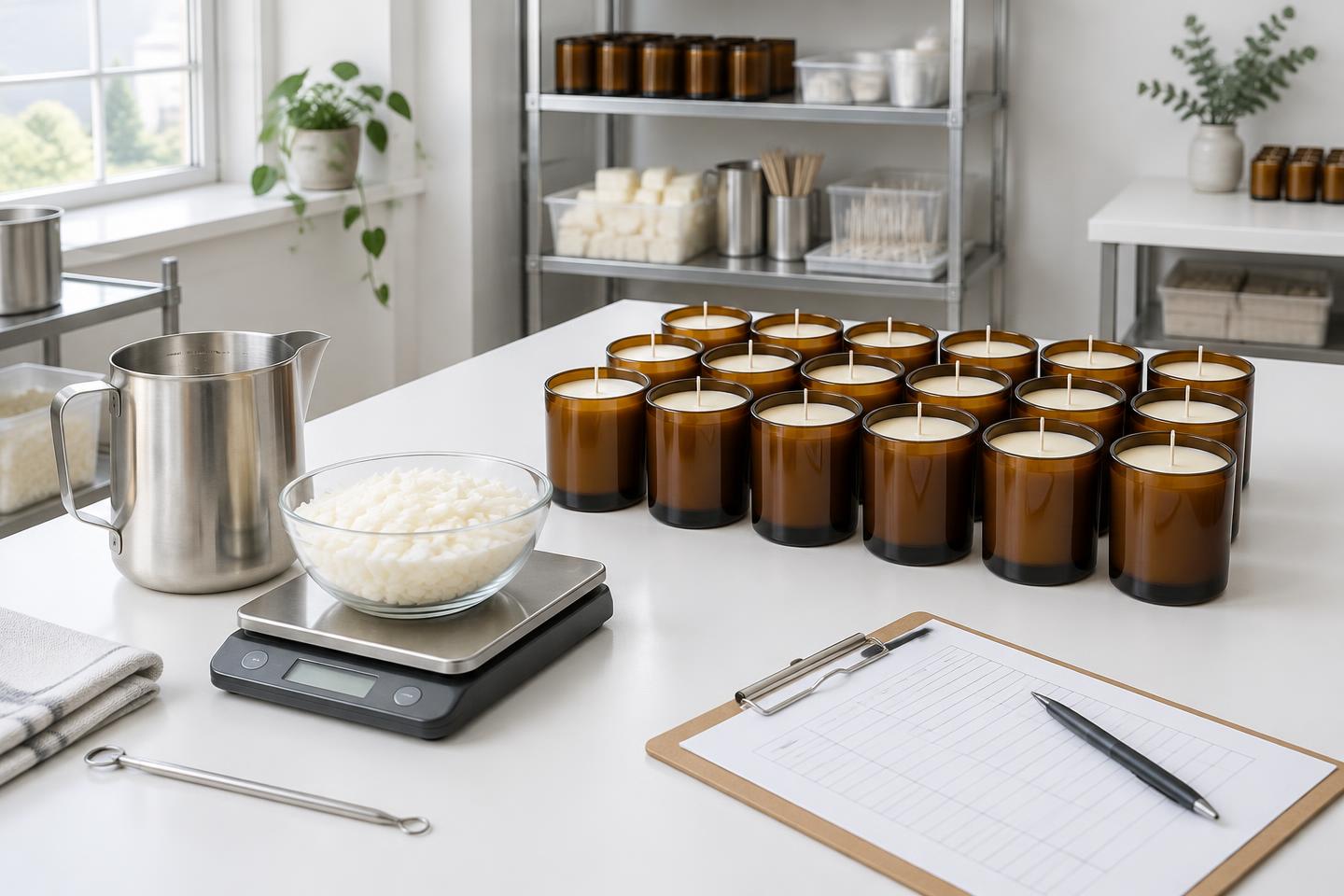
The short answer: scaling candle production is not only multiplying every ingredient by the desired unit count. The arithmetic scales directly; your equipment, working time, heat retention, mixing path and process loss may not. Increase volume in controlled steps, record the actual first and last vessels poured, and recheck the finished product before treating the larger method as proven.
CandleScience describes large-batch candle making as production ranging from a few dozen to hundreds in a session, often through several pours. For a small studio, the useful threshold is simpler: a batch becomes operationally different when your proven method no longer fits one ordinary pitcher, one comfortable mixing cycle or one consistent pour window.
Separate recipe scale from process scale
| Element | Can you multiply it? | What still needs checking |
|---|---|---|
| Wax and fragrance weights | Yes, using the same percentage basis | Scale capacity and measurement resolution |
| Vessels, wicks and labels | Yes, plus extras for holds or damage | Correct component lots and setup accuracy |
| Heating and cooling time | No universal multiplier | Actual temperature history and room conditions |
| Mixing method | Not automatically | Reach, uniformity and elapsed time |
| Process loss | Estimate, then measure | Residue, spills, test units and underfills |
Calculate a theoretical batch first
For 24 fictional candles at a verified 200 g mixture target and 8% wax-basis fragrance load, total mixture is 4,800 g. Wax is 4,800 ÷ 1.08 = 4,444.44 g; oil is 355.56 g. Those figures describe the product that should reach the vessels. They do not include material left in the melter or pitcher.
Measure process loss instead of adopting a universal waste percentage
No single loss allowance fits every studio. A small pitcher, a transfer hose and a large melter retain different amounts. Weigh or calculate how much good mixture entered the process and how much saleable product plus recorded samples came out. Keep spills and rejected units visible rather than burying them inside a generous recipe.
Fictional 4,800 g batch. The 120 g loss is an example, not an industry benchmark. Your own completed batches should establish the allowance.
Chart data
| Item | Value ( g) |
|---|---|
| Saleable fills | 4560 g |
| QC sample | 120 g |
| Measured residue/loss | 120 g |
In the fictional example, recorded output is 4,680 g and measured loss is 120 g, or 2.5% of input. If similar runs repeatedly land near that figure, a planning allowance can be based on evidence. Continue recording actuals: changing equipment or batch size can change the rate.
Scale in checkpoints, not one giant jump
- Confirm the small recipe and test record before increasing volume.
- Choose the next batch size that your scale, heating vessel and pitcher can handle without improvised overfilling.
- Record actual heat, mix and pour observations rather than copying the small-batch target as if it happened.
- Compare fill weight and appearance from the first, middle and last vessels poured.
- Run the appropriate finished-product checks and burn tests before making the scaled method your production standard.
Doubling is a convenient example of an incremental step, not an industry rule. A jump from 6 to 12 may be trivial in one setup and require new equipment in another. The defensible approach is to define what changed, collect comparable evidence and avoid committing a major order to an unverified process.
Watch the pour window
A larger mass may retain heat differently while filling more vessels takes longer. Record first-pour and last-pour conditions and compare their finished surfaces and weights. If the mixture must be reheated, document what happened and obtain guidance for the exact wax and fragrance rather than assuming unlimited heat cycles have no effect.
| Measure | 12-unit baseline | 24-unit trial | Decision |
|---|---|---|---|
| Actual input | Recorded | Recorded | Verify formula and scale readings |
| First/last fill weight | Within internal target | Compare both ends | Adjust handling only with evidence |
| Measured residue | Record grams | Record grams | Update planning allowance after repeated runs |
| QC and burn results | Approved combination | New scale checked | Release or continue testing |
Capacity planning belongs before the pour
Count curing space, safe work surface, vessel setup time, labels and packaging—not only melter capacity. A batch that can be heated but cannot be poured consistently or stored safely is larger than the current process supports. Likewise, confirm materials before heating; the inventory-management guide explains reorder points and batch sufficiency.
WaxLogic can hold recipe quantities, planned batches and actual production outcomes in one workflow. Use the jar fill-weight guide to establish the per-unit target, the free candle calculator to check the arithmetic, and the batch QC checklist to document whether the larger method earns approval.
Run your candle business in one place
Inventory, recipes, production, wholesale and invoicing — 7 days free, no card needed.
Start free trial