
The Pour Logic: candle jar size, fill weight and the fluid-ounce trap
October 7, 2026 · 6 min read
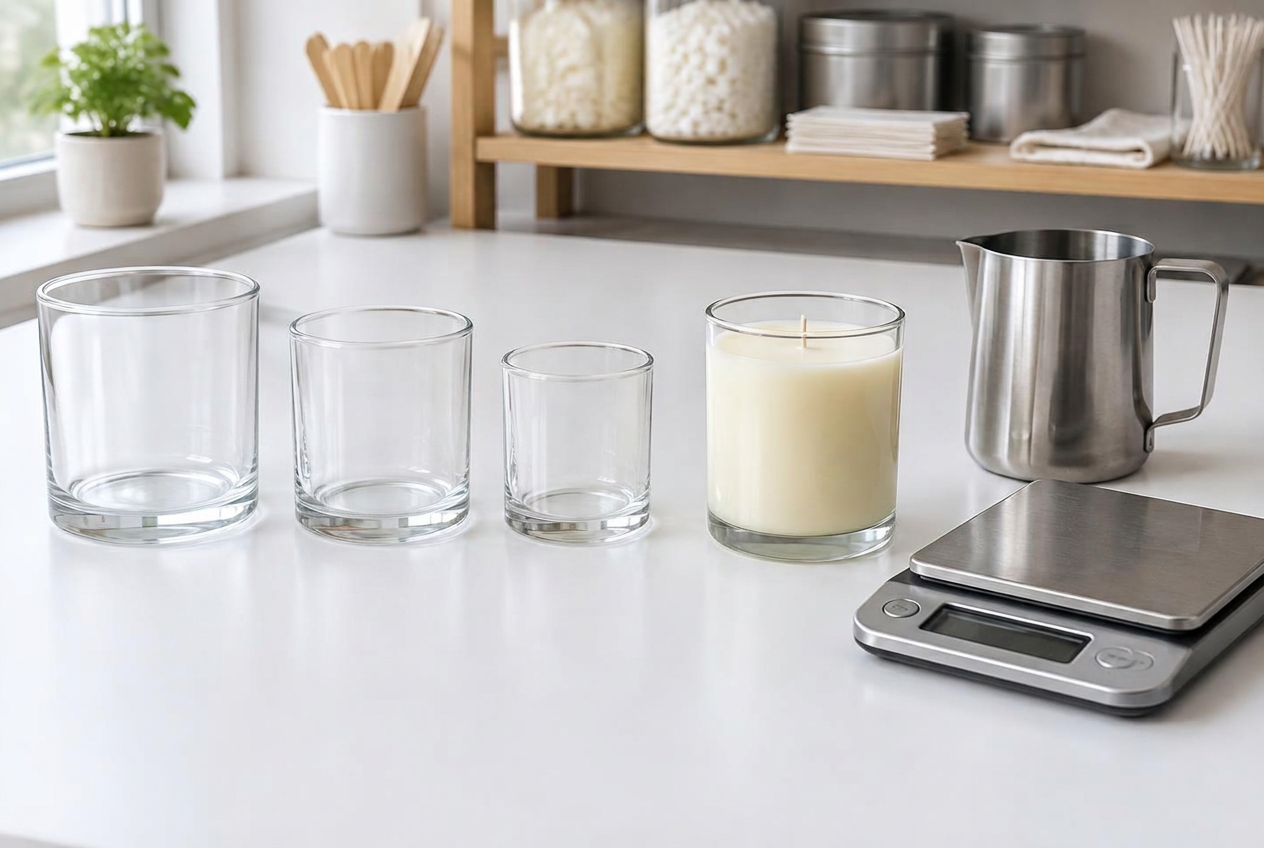
The short answer: a jar's advertised size is not always the weight of candle mixture you should pour into it. Fluid ounces measure volume; ounces by weight measure mass. Supplier names may use nominal capacity, overflow volume, wax fill weight or another convention. Check the exact container specification, establish a safe intended fill line and verify your finished recipe by weighing a test candle.
This matters for more than avoiding leftover wax. A mistaken fill assumption affects batch yield, fragrance requirements, cost per candle and the quantity stated on your packaging. If you sell candles and wax melts, the same distinction applies to mold or clamshell capacity, although the product's instructions and intended use differ.
Four measurements hiding behind one jar name
| Term | Meaning | Use |
|---|---|---|
| Nominal jar size | The supplier or manufacturer's product name | Identification, not a guaranteed recipe weight |
| Overflow volume | Liquid capacity all the way to the brim | Container comparison, not your pouring target |
| Volume to intended fill line | The space actually available for your mixture | Starting point for a capacity estimate |
| Net candle fill weight | Actual wax-and-fragrance mass, excluding packaging | Production target and labeling input |
CandleScience's container information explicitly separates approximate wax weight to a fill line from volume to overflow. It also notes that manufacturer size labels can reflect unrelated conventions, including the weight of honey a container holds. That is why 'an 8 oz jar needs 8 oz of wax' is not a dependable rule.
Measure usable capacity with water
- Choose a candle-safe vessel and establish the intended fill line using supplier guidance and product testing. Do not default to filling to the brim.
- Place the empty vessel on a stable scale and tare it, or record its empty mass separately.
- Add water to that intended line and record the net water weight. Repeat on more than one vessel if practical.
- Empty the vessel and dry it fully before any candle-making use. Water left in equipment or a jar is not part of the recipe.
- Use the wax or mixture density guidance as an estimate, then verify with the actual recipe and a trial pour.
A water measurement is a way to estimate available volume, not permission to assume water and wax weigh the same. At ordinary room conditions, a gram of water is approximately a milliliter, which makes it a convenient reference. Wax and fragrance mixtures have different densities. There is no single density factor that is exact for every wax blend, oil and temperature.
From capacity estimate to a real fill target
Suppose a fictional jar holds 230 g of water to the chosen line. If you use an illustrative mixture-to-water density factor of 0.86, your starting estimate is 230 × 0.86 = 197.8 g of candle mixture, approximately 6.98 oz by weight. This is a planning estimate—not measured supplier data for your wax, and not a universal soy density. Make a trial candle and weigh the cooled result to establish the real target.
In that example, you would not label the product as 8 oz of candle mixture merely because the jar has an 8 oz name. Determine the accurate net quantity for your finished product and follow the labeling rules in the market where you sell. This guide explains production math; it does not establish legal net-quantity tolerances or replace a compliance review.
Split a known target into wax and fragrance
Worked arithmetic, rounded to two decimals: 185.19 g wax + 14.81 g oil = 200.00 g. The oil is 8% of wax weight, not 8% of the total. The target weight is assumed, not derived from a particular jar.
Chart data
| Item | Value ( g) |
|---|---|
| Wax | 185.19 g |
| Fragrance | 14.81 g |
In ounces by weight, the same 200 g target is about 7.055 oz: approximately 6.532 oz wax and 0.523 oz oil. A scale's resolution matters, especially for small oil quantities. Use enough precision for the batch you are making and round at the final weighing step, rather than rounding each per-candle ingredient and then multiplying a large error across dozens of candles.
Scale the recipe, then check actual yield
| Quantity | Wax | Oil | Total mixture |
|---|---|---|---|
| 1 candle | 185.19 g / 6.532 oz | 14.81 g / 0.523 oz | 200 g / 7.055 oz |
| 12 candles | 2,222.22 g / 78.387 oz | 177.78 g / 6.271 oz | 2,400 g / 84.658 oz |
| 24 candles | 4,444.44 g / 156.773 oz | 355.56 g / 12.542 oz | 4,800 g / 169.315 oz |
The table assumes zero process loss. In practice, wax remains in a pitcher and some units may need rework or be held for testing. Estimate loss from your own recorded batches. If you choose to prepare 3% extra mixture, multiply both ingredient quantities by 1.03 so the load stays unchanged. Adding only extra wax would change the fragrance ratio; adding only extra oil would change it in the opposite direction.
Changing vessel size is also a testing decision
A larger jar is not simply a bigger serving of an approved candle. Diameter, shape and vessel material can change burn behavior and wick selection. Recalculate the fill, select candidate wicks using supplier guidance and test the new complete product. Likewise, a wax-melt clamshell may have a nominal capacity that differs from the weight of your chosen mixture; measure and test the exact mold and melt wax.
For container candles, leave the headspace specified by the vessel and your validated process. There is no universal headspace number in this article. Follow the National Candle Association's safety guidance for consumer-use context and obtain the technical guidance relevant to your product before release.
A five-point check before the next production pour
- I know whether the supplier's size is nominal, overflow volume or an estimated wax fill weight.
- My intended fill line is documented and my cooled test candle establishes the actual net fill target.
- My recipe states fragrance load on a clear percentage basis and uses weights, not spoonfuls or liquid ounces of oil.
- My batch math scales both wax and fragrance together and keeps any loss allowance explicit.
- The specific vessel, wick, wax and fragrance combination has completed the appropriate testing before sale.
Use the free WaxLogic candle calculator for a starting batch estimate, then replace assumptions with your trial-pour measurements. The fragrance-load guide explains the ratio, the IFRA vs wax-limits guide separates compliance from recipe performance, and the batch quality checklist helps keep the confirmed fill target consistent from one pour to the next.
Run your candle business in one place
Inventory, recipes, production, wholesale and invoicing — 7 days free, no card needed.
Start free trial