
Batch Logic: candle dye calculations for consistent color from test pour to production
October 8, 2026 · 4 min read
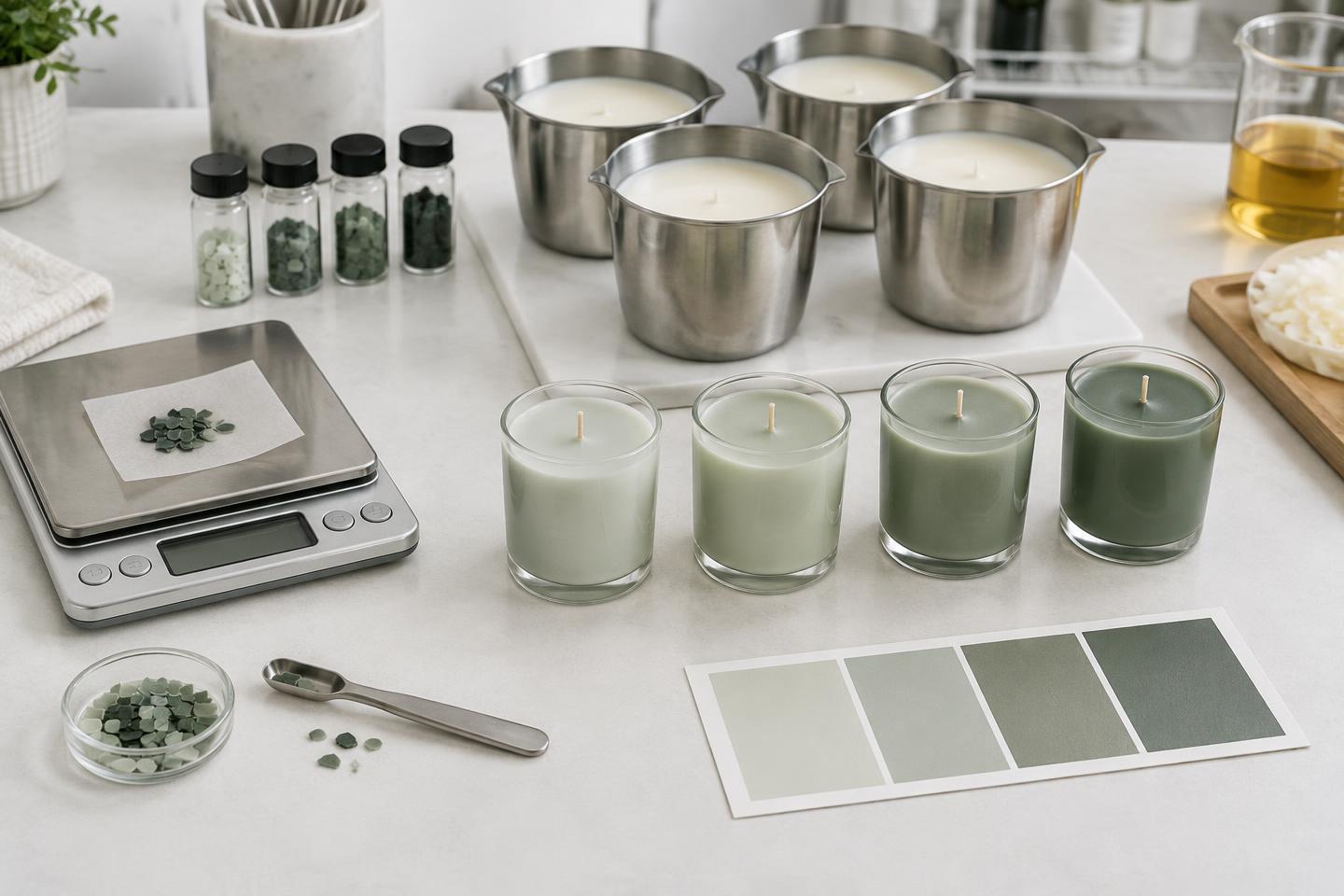
The short answer: calculate candle dye from the wax weight using the usage guidance for your exact dye, then preserve the formula in weight units. Drops, shavings and color names are poor production specifications because droppers, chips, waxes and human perception vary. A repeatable color record names the dye product and lot, wax and lot, fragrance, measured dose, process and cured comparison result.
There is no universal dye percentage. Liquid dyes, blocks, chips and powders have different concentrations, and manufacturers publish very different starting ranges. Use the technical sheet for the product in your hand. Any percentage below is teaching math, not a recommendation for a particular dye.
Use one weight-based equation
For an oil-dispersible liquid dye whose supplier specifies dosing by total wax weight, the equation scales cleanly. But your scale must resolve the amount. A kitchen scale reading whole grams cannot reliably measure 0.50 g. Increase the test batch, use suitable equipment or follow a supplier-approved dilution method rather than pretending a displayed zero is precise.
| Wax weight | Calculation | Dye weight |
|---|---|---|
| 250 g | 250 × 0.0005 | 0.125 g |
| 1,000 g | 1,000 × 0.0005 | 0.500 g |
| 5,000 g | 5,000 × 0.0005 | 2.500 g |
Why counting drops fails at production scale
Drop size changes with the dispenser, angle, temperature and liquid viscosity. One maker's 10 drops may not equal another's. Drops can be useful for an informal exploration when the supplier instructs that method, but translate the chosen result into a controlled production measurement before promising matched batches.
Build a shade ladder
- Choose one wax, fragrance, dye and process for the experiment.
- Make a no-dye control and several small steps within the supplier's usage guidance.
- Label every sample before pouring and record actual weights.
- Cool and cure the samples for the same interval under comparable lighting.
- Select the lightest dose that achieves the target, then complete the appropriate burn testing.
Pure arithmetic at four fictional test percentages. These are not recommended rates and do not predict perceived color; consult the exact dye's technical sheet.
Chart data
| Item | Value ( g) |
|---|---|
| 0.01% | 0.1 g |
| 0.03% | 0.3 g |
| 0.05% | 0.5 g |
| 0.08% | 0.8 g |
The chart is intentionally a dose chart, not a color-performance chart. Perceived shade does not increase in a guaranteed straight line. Natural soy's opacity, wax color, fragrance discoloration, vessel color and lighting can all change what a customer sees.
Record color as a complete formula
| Field | Why it matters |
|---|---|
| Dye identity and lot | Distinguishes concentration or supplier changes |
| Wax identity and lot | Base color and opacity affect the result |
| Fragrance and load | Some formulas discolor or interact visually |
| Dye weight and percentage basis | Makes the dose reproducible |
| Process and comparison interval | Hot liquid wax does not show the final cooled shade |
| Reference sample or measured color | Defines what 'sage green' means for this product |
For advanced production, a colorimeter or spectrophotometer can express color in numerical coordinates and compare a sample with a target. Konica Minolta's color measurement overview shows how instrumental color control is used for batch consistency in colored materials. Most solo candle makers do not need laboratory equipment; a retained physical standard viewed under controlled lighting is already stronger than memory.
More dye can change more than appearance
Dye becomes part of the tested candle system. Heavy color can affect burn behavior, and changing dye form or dose means the approved wick result may no longer apply. Do not wick up automatically based on color alone; make candidate candles and test the revised formula. Supplier instructions for compatible waxes, incorporation and maximum usage remain essential.
WaxLogic recipes can preserve measured dye as a material alongside wax, fragrance, wick and vessel. Read the wick-testing guide before approving a changed shade, use the batch QC checklist to compare production runs, and calculate the rest of the mixture with the free candle calculator.
Run your candle business in one place
Inventory, recipes, production, wholesale and invoicing — 7 days free, no card needed.
Start free trial